
Written by Karin Schroeder *
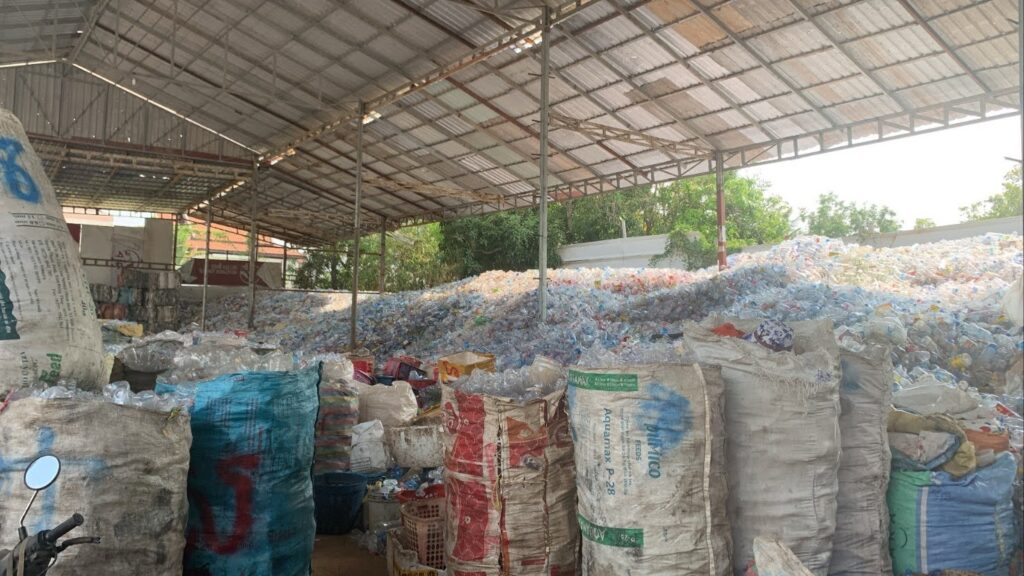
Believe it or not, the photo above was taken in the religious capital of Cambodia: Siem Reap. This bustling urban center is home to many stunning, culturally significant sites, including the world’s largest temple complex Angkor Wat. In addition to the city’s exceptionally kind inhabitants and
amazing food, Siem Reap is also home to many recycling depots.

A recycling depot is where recyclable materials can be
bought from waste pickers or buyers, then prepared to be
sold to another, larger depot or to a recycling center out
of the city (Friese & Nicholson, 2022). The individuals
doing such work are known as urban recyclers, and most
cities around the world have workers participating in this
or a similar activity vital to protecting urban ecosystems
(Anierobi & Efobi, 2013). However, very little attention
is given to these workers in academia, and perhaps even
less respect is given by the communities they serve
(Gidwani & Reddy, 2011).
The urban recyclers of Siem Reap are no exception,
which I know for a fact as I had the opportunity to study
abroad and conduct directed research there during the
spring of 2023. As someone with a great appreciation for
nature’s role in the built environment, I chose to focus
my project on Siem Reap’s urban recycling.
The research process involved building on an existing body of work from the previous class of students – who concluded in part that due to the relatively recent influx of consumer waste and goods to Southeast Asian countries from Western economies, formerly non-plastic reliant societies have been acquiring unprecedented amounts of solid waste (Friese & Nicholson, 2022). No history of plastic reliance means no formal recycling infrastructure, and hence recycling fell to the informal sector (ibid). Informal work means essentially no protections, and informal workers like urban recyclers are often driven to this occupation due to limits to education, slow job growth, disability, landlessness, lack of capital, or gender norms (House, 1984; Anierobi & Efobi, 2013; ibid).
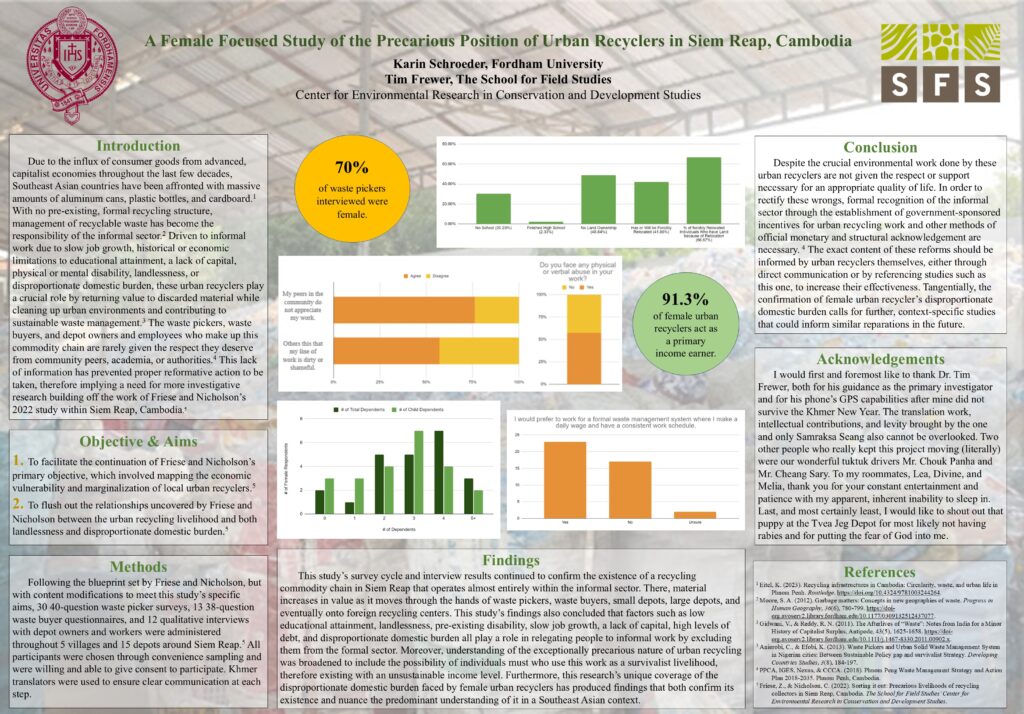
I was specifically drawn to the disproportionate reproductive burden faced by female urban recyclers – who are often excluded from formal sector work in Siem Reap due to cultural norms about child rearing and pregnancy – so they became the focus of my research (Field Interviews with Survey Subjects, April 2023). Through the conduction of field interviews/surveys and the resulting data analysis, this research was able to support the assertions made by the previous paper regarding the drivers to informal work and the less-than-ideal working conditions of local urban recyclers. The data also showed that 70% of waste pickers interviewed were female and 91,3% of female urban recyclers surveyed were their family’s primary income earner, suggesting disproportionate reproductive burden.
Curious to learn more? My research in Siem Reap created the backbone for my senior thesis, which
you can read here:https://research.library.fordham.edu/environ_2015/158/
Karin Schroeder
Beinsitu Sustainability Institute Volunteer
MSc in Sustainability Management, UPF-BSM, BA in Environmental Studies, Fordham University
Feel free to reach out and ask any questions on my LinkedIn:
www.linkedin.com/in/karin-schroeder-5122a4200
References
– Friese, Z., & Nicholson, C. (2022). Sorting it out: Precarious livelihoods of recycling collectors in
Siem Reap, Cambodia. The School for Field Studies’ Center for Environmental Research in
Conservation and Development Studies.
– Gidwani, V., & Reddy, R. N. (2011). The Afterlives of “Waste”: Notes from India for a Minor History
of Capitalist Surplus, Antipode, 43(5), 1625-1658.
https://doi-org.avoserv2.library.fordham.edu/10.1111/j.1467-8330.2011.00902.x.
– House, W. (1984). Nairobi’s informal sector: Dynamic entrepreneurs or surplus labor? Economic
Development and Cultural Change, 32(2), 277-302. https://doi.org/10.1086/451386.
– Anierobi, C., & Efobi, K. (2013). Waste Pickers and Urban Solid Waste Management System in
Nigerian cities: Between Sustainable Policy